Monday, December 13, 2010

Graphic Tape Illustrations in The Rocket

Illustration for an interview with Dr. Judith Lipton by Robert Newman, discussing the 'Target Seattle' campaign in 1982.

Images from the 1984 presidential campaign:

Cowboy Ronnie

Walter Mondale

Gary Hart

Jesse Jackson

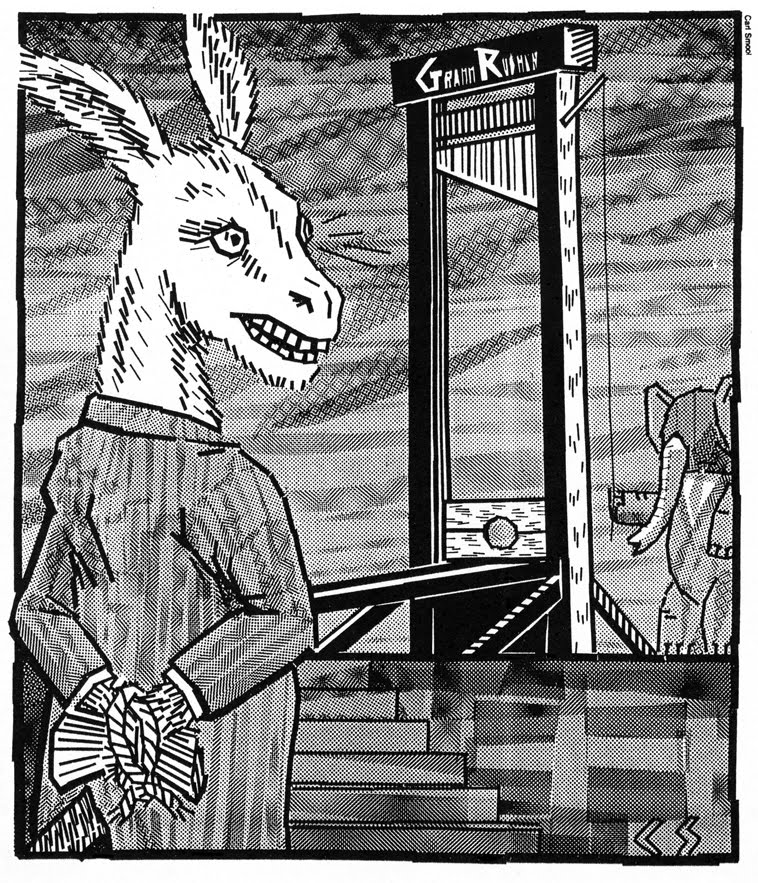
Democrats face Gramm Rudman
Ruben Blades

Illustration for an article on teen curfew by Megan Kelso, a senior at Garfield High School in 1986

Thursday, December 9, 2010

You Can Be Dead

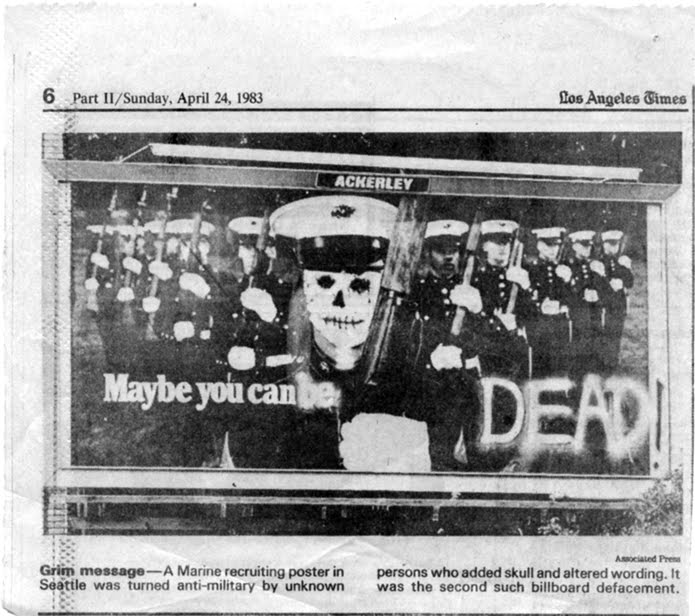
In the spring of 1983 billboards promoting enrollment in the Marines appeared in Seattle and around the nation. When one of these appeared in Belltown, an opportunity for appropriation presented itself. In this case the face was pealed away and a little spray paint completed the skull's expression and the revised message to confront the promotion of militarism in our culture. In the following day's papers, much to the participants' surprise, there had been two billboards done the previous night.

The second billboard was located on Eastlake Avenue.

The fact that there were two groups altering billboards was never reported in the media, but once again, provocative news travels fast.

A clipping from the Los Angeles Times

A piece from the AP wire a few days later announced that Marine billboards had been altered in Eugene and in Salem. This was sent to me by one of my press contacts.

Four years later, Regina Hackett wrote an article in the Seattle Post Intelligencer on unsanctioned art in Seattle. The article prominently featured the "You Can Be Dead" billboard and maintained the anonymity of the artists.

Burnt Offering

"Burnt Offering" was created for the windows of Art In Form, an art bookstore established by Laura Millen and Annie Grosshans in my former studio space on the corner of Second Avenue and Bell Street. The piece was conceived in support of a Fire Sale that was being held on the first anniversary of a fire that had been set on the back stoop of the building, causing considerable smoke damage and ending the residential space upstairs. The title referred to the planed incineration of the skeletal cityscape, fashioned from cardboard and embellished with jos paper and fireworks.


detail

One night, shortly before the end of the sale, the glittering city was shifted to the adjacent window and a blackened wreckage was installed in the corner windows along with the words "This City Will Burn."


The cryptic Burn invitation

On the last day of the sale, the entire installation was transported two blocks north and installed in front of the old boiler-room building in the alley behind my studio. A small group of people who knew about the plan gathered in the space as preparations were made. Just in case, a hose was also at the ready.


Ignition Black and white photos are by Cam Garrett.


The fire was brief and loud and sent up a dark cloud of smoke which caught the eye of a local resident who called the fire department, which was conveniently only 3 blocks away. The siren scattered the crowd and by the time the truck arrived the fire was merely embers which were quickly extinguished. A fire-woman seemed delighted at the idea and asked that they be invited 'next time.'

A notice of Violation was issued, marking the end of a lovely event.

Tuesday, December 7, 2010

CItyFair, 1982


Mark Sullo and I with our quick collaboration for CityFair 1982, which featured Mark's Belltown photography and my favorite quote from Lillian Hellman's play "The Little Foxes."

CityFair started in 1980 as "a 5-day event intended to help people to lower costs and improve the quality of life in the city." Held at the Seattle Center Exhibition Hall, the event attracted more than 4,000 people each year. In 1980, Buster Simpson headed CityFair/Arts. I think that it was a great idea that might be worth re-visiting, which you can do briefly via History Link here.

The quotation is from the History Link CityFair entry.

Neutron Bomb


Altered Billboard, 1st Ave. and Bell Street, Seattle. Photo postcard by Mark Sullo

One evening in the middle of August, 1981, I was working in the studio and listening to NPR when it was announced that President Reagan had authorized the renewed production of neutron bombs. A neutron bomb, or Enhanced Radiation Weapon, while less explosive than an atomic bomb would release increased radiation meant to destroy people while preserving property. I found this news very disturbing so I left the studio and walked back to where I was living at Second and Bell. When I got to First and Bell I stopped in my tracks. There on the north side of Egberts was a billboard proclaiming "Hollywood Bowled Over By Kent III Taste!" Instantly I was struck with a stunning idea: simply appropriate one 'death ad' and convert it to a big anti-death message that would confront the news I had just heard. 
I announced the idea when I got home, and with a couple of compatriots laid out the plan. We dubbed ourselves SSS. The library provided a signed press photo of Reagan from "Bedtime for Bonzo," which was enlarged to fit over the cigarette pack. Appropriate type was painted to fit the space, and in the very early morning of August 18th, the conversion was completed in approximately 2 minutes. A quick call to a press contact landed the image in the local papers and on the AP wire where it was circulated around the country.  Surprisingly one SSS member appeared in that photo.  Rarely is the turnaround from idea to results so quick and gratifying. I and others found this strategy useful in the following years. I will share some of those projects in coming posts.


A clipping from The New York Daily News

I want to acknowledge that I became aware of this strategy more than a year earlier when I visited artist Mark Pauline at his junkyard studio in San Francisco. Mark had been doing this kind of work there sometimes brazenly in the light of day.
Also, I recently found online an interesting article, "Culture Jamming: Hacking, Slashing and Sniping in the Empire of Signs" by Mark Dery, that mentions the neutron bomb billboard under the heading "Billboard Banditry." You can find it here.
For more on billboard alteration, check out the Billboard Liberation Front.

Monday, December 6, 2010

Belltown Gets Baked

In 1980, Buster Simpson started a new, if somewhat short-lived, tradition of serving up a huge root pie in celebration of Ground Hog Day. The pie was baked at the Belltown Cafe in the great metal bell pan that was created for the event. Here I am dishing up a steaming serving... yum!

Sunday, December 5, 2010

Miscellaneous


Shortly after moving to my first Belltown studio upstairs from Consolidated Press at Bell Street and 1st Avenue, I landed my first art gig, designing and fabricating mascots for the Pike Place Market. These costumes were completed in 1978, and lead to several years of producing similarly sculptural work for a wide range of clients including the original Starbucks.

Belltown was the perfect place to learn on your feet. Through my friendship with next door neighbor and artist Heather Ramsay, I began producing occasional props for the Rep and other Theaters including The Empty Space. Through the social hub of the Belltown Cafe, I met the Seattle Mime Theater and began costuming shows for them including Cinderella (above), Jack and the Beanstalk, and The Emperor's New Clothes. I also worked with Michael (Haute Pants) Murphy to produce props and costume pieces for the Seattle Opera. In 1978 On the Boards leased Washington Hall to present local, national and international contemporary performance. It was there that I worked on several of Norman Durkee's binaural operas, and later created the sets and costumes for his show Without Law/Without Heaven. My work in theater expanded my understanding of collaboration and my interest in culture as kinetic experience.


recycled bird 1978

Bumbershoot, Seattle's Arts Festival, provided great opportunities for collaborative projects. In 1978, I joined with a group of artists to create "Bumberzoo," an outdoor installation largely made from recycled materials gathered from places like Boeing Surplus and Washington Liquidators.

For Bumbershoot 1982, Wendy Brawer organized "Regrade School," where each artist got a desk to embellish and other school room props to create. I immediately knew what to do with my extensive pencil stub collection.

Prior to moving to Belltown, I worked at Copy Mart which had acquired one of Seattle's first 6500 color Xerox machines. I met numerous local artists over the counter there, and I began to play with the new medium myself. In 1978, Ries Niemi curated an exhibit of color xerox art for And/Or, where I showed several pieces including:

30 Washingtons 1978


It was also during this period that I created my first illustration using graphic border tape for a single released by The Features, a band I was friends with. The piece caught the eye of Helene Silverman and Mark Michaelson of Square Studios and The Rocket where I was soon creating edgy political graphics.

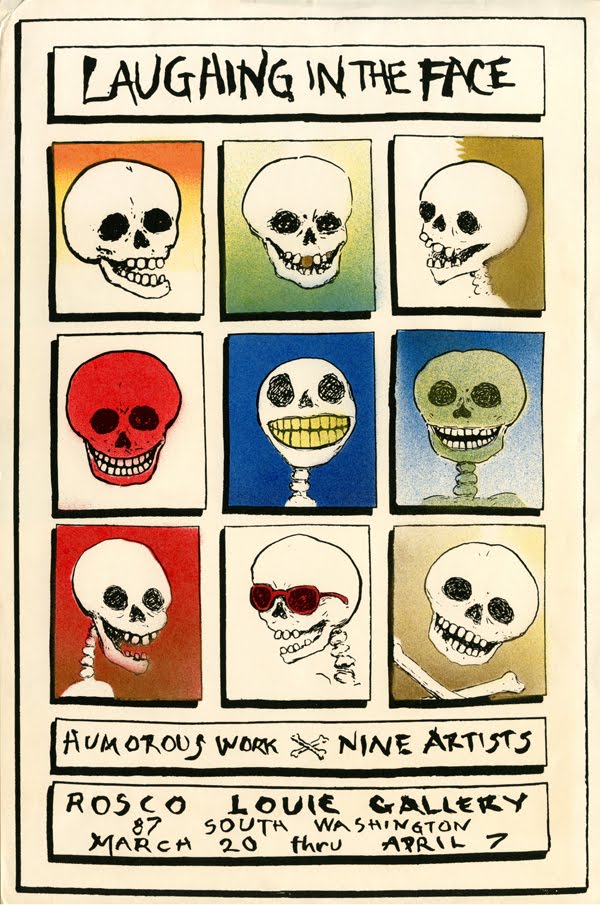
The Rosco Louie Gallery played a large roll in the growing art scene, and in 1980 I curated a show of humorous and provocative work. The poster above featured some of my earliest skeleton drawings. Unfortunately I wasn't able to attend the show as I had just taken off for an extensive trip to Mexico, where I would be inspired to explore 'calaveras' further.

Silkscreen poster by Randy Eriksen, 1979

Tracey Rowland is holding the "Soft Machine Gun" that I created for the show in this photo and poster by Randy Eriksen (Rosco).